The Texas "Merry Christmas Bill"
Maria Mejia
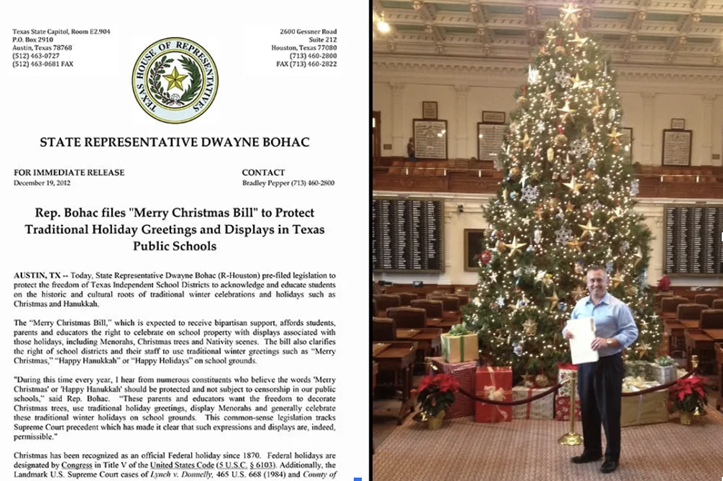
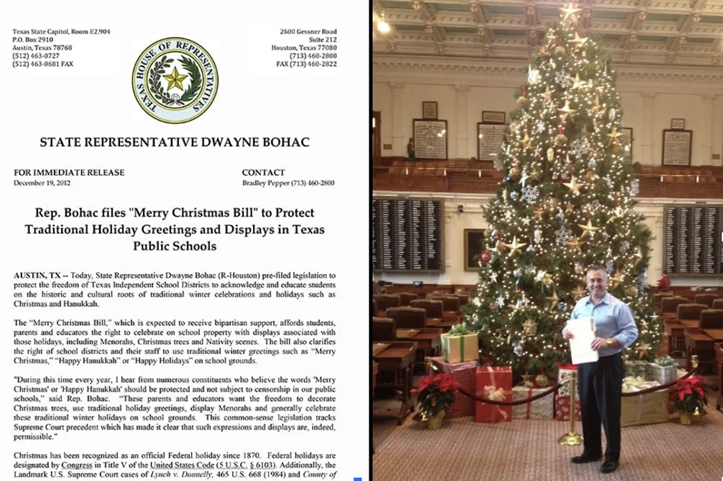
You know how schools often seem very careful about saying “Merry Christmas” or putting up holiday decorations? In 2013, the Texas Legislature passed a law known as the “Merry Christmas Bill,” or House Bill 308, to address this issue. Essentially, the state government stepped in to clarify that schools may recognize holidays. The law states that teachers and students may use traditional greetings such as “Merry Christmas,” “Happy Hanukkah,” or “Happy Holidays” without fear of punishment. It also allows public schools to display holiday decorations, including a Christmas tree or a menorah. However, if a school chooses to include a religious display, it must also include symbols from other religions or a secular, non-religious symbol, such as a snowman.
For someone trying to understand how laws affect everyday life, this bill is essential because it provides a clear example of the government regulating what can be said or displayed in a public space, specifically, a school hallway. It shows how lawmakers attempt to resolve conflicts arising from cultural and religious diversity within public institutions.
As a tenth grader considering a future career in law, I find this bill especially interesting because it demonstrates how the legal system works in practice. When studying the Constitution, students learn about the First Amendment, which addresses religion. One part, the Establishment Clause, prevents the government from establishing an official religion, while another part, the Free Exercise Clause, protects individuals' rights to practice their own faith. House Bill 308 represents the Texas Legislature’s attempt to balance these two principles. The law seeks to ensure that public schools are not promoting Christianity while also protecting the right of students and teachers to express themselves. I find it fascinating to analyze whether this law successfully protects religious freedom or instead creates new confusion, making it a strong example of how laws are written to address real-world cultural issues.
The Texas "Merry Christmas Bill"
(December 2025) by Maria Mejía
© 2025. All rights reserved.
Address
Skyline High School
Legal Studies Magnet Program
7777 Forney Rd
Dallas, Texas 72227
Contact
info@SkylineLaw.org
Att: Mr. H. Rodriguez, Lead Teacher