I am Vanessa Guillen
Valeria Cortez
10/30/2025
By Valeria Cortez
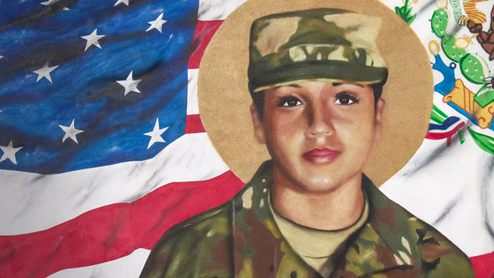
On December 27, 2021, President Joe Biden signed the I Am Vanessa Guillén Act into law. This landmark legislation was named after Vanessa Guillén, a 20-year-old Hispanic American soldier stationed at Fort Hood, Texas. Her story exposed deep flaws in how the U.S. military handled sexual harassment and assault.
Vanessa Guillén went missing on April 22, 2020. Before her disappearance, she had told her family that she was being sexually harassed by fellow soldiers and by a supervisor. For months, her family searched for answers as the Army failed to take her complaints seriously. On June 30, 2020, Vanessa’s dismembered and burned remains were discovered near the Leon River, not far from Fort Hood. Investigators determined that her supervisor, Aaron Robinson, had bludgeoned her to death in an armory on base. When confronted by police, Robinson fled and fatally shot himself. His girlfriend, Cecily Aguilar, later pleaded guilty to helping dispose of Vanessa’s body and to obstructing justice by destroying digital evidence and lying to investigators.
The tragedy quickly gained national attention and sparked outrage across the country. Millions of people followed Vanessa’s story through the news and on social media, demanding answers from the Army and justice for her family. The hashtag #IAmVanessaGuillén became a rallying cry for survivors of military sexual assault who had long felt silenced or ignored. Protesters filled streets across Texas and beyond, calling for the Army to be held accountable. Vanessa’s mother, Gloria Guillén, became one of the most powerful voices in the movement, meeting with lawmakers and even speaking directly to President Biden to push for legislation that would protect service members from enduring the same suffering as her daughter.
Before this law was enacted, cases of sexual harassment and assault within the U.S. military were handled internally by the chain of command. This meant that commanding officers, rather than legal professionals, had the authority to decide whether to proceed with an investigation or prosecution. Often, commanders knew the accused personally, creating a serious conflict of interest. This system led to bias, retaliation, and a widespread lack of accountability. Many victims who came forward faced being ignored, reassigned, or ostracized for speaking out. In some cases, their military careers were permanently damaged. Reports from the Department of Defense showed that thousands of service members experienced sexual assault each year, yet only a small percentage of those cases ever resulted in criminal convictions.
Vanessa’s death became a turning point that could no longer be ignored. Her case highlighted the dangerous culture of silence that had existed in the military for decades. The I Am Vanessa Guillén Act was written to address this systemic failure. The act introduced historic reforms to the Uniform Code of Military Justice, the legal framework that governs all U.S. military personnel. Its primary purpose is to ensure that cases of sexual harassment and assault are investigated independently and handled by trained prosecutors rather than the victim’s chain of command.
The law transferred prosecuting authority for sexual assault and related crimes to independent military lawyers known as special trial counsels. This change ensures that decisions about such cases are made by individuals with legal expertise rather than by commanding officers with personal or professional ties to the accused. The law also established stronger protections for victims by requiring the Department of Defense to track allegations of retaliation, report outcomes transparently, and notify victims about the progress and results of their cases. In Texas, the legislation inspired the creation of a Sexual Offense Prevention and Response Program for the Texas Military Department, which focuses on improving response training and support for survivors.
Many believe Vanessa’s death could have been prevented if her initial complaints had been handled properly. Reports revealed that Vanessa had made multiple complaints about harassment before her murder. In one instance, a supervisor allegedly made sexually explicit remarks in Spanish, and in another, a soldier approached her while she was bathing in the field and attempted to touch her. Her family’s attorney, Natalie Khawam, stated to The Texas Tribune that the Army’s investigation into Vanessa’s case was more about “damage control” than genuine accountability. The report, she said, concealed the names of individuals who had been accused of harassing Vanessa, proving that officials prioritized protecting the Army’s image rather than its soldiers. Had these reports been taken seriously, Vanessa might still be alive today.
The I Am Vanessa Guillén Act is more than just a legal reform—it is a powerful symbol of justice and courage. It serves as a promise that the voices of victims will no longer be silenced. For decades, the military has struggled to address the issue of sexual assault within its ranks, often choosing to preserve its reputation instead of protecting its people. This law represents a major shift toward transparency, fairness, and accountability. Removing decision-making power from the chain of command sends a clear message that no one, regardless of rank or position, is above the law.
The act also empowers survivors, giving them hope that their voices will be heard and that justice is possible. It acknowledges that silence has cost too many lives and careers and that the time for change is long overdue. It stands as an example of how the law can evolve in response to public demand and moral necessity.
It is heartbreaking that it took the loss of such a young life to spark this change. Vanessa Guillén was only twenty years old, having just graduated from high school, with her entire future ahead of her. Her story serves as a painful reminder of the consequences of negligence and inaction. But out of this tragedy came transformation. The I Am Vanessa Guillén Act ensures that her name will live on not as a symbol of injustice, but as one of courage, change, and hope.
Vanessa’s legacy reminds us that politicians or policymakers do not just shape the law—it is shaped by people who stand up, demand justice, and refuse to be silent. Through her family’s persistence and the public’s outrage, the nation was forced to confront a truth that had been ignored for too long. Today, because of the law bearing her name, countless service members have stronger protections and a fairer chance at justice.
The I Am Vanessa Guillén Act stands as a lasting testament to the power of one person’s story to inspire reform and save lives. It shows that even in the face of unspeakable tragedy, change is possible when the public demands it. Vanessa’s courage, her family’s determination, and the movement that followed turned heartbreak into hope and transformed pain into progress. Her story will continue to remind us that justice delayed is not justice denied—and that every voice deserves to be heard.
Works Cited
Yang, A., & Martinez-Ramundo, D. (2020, September 12). Army officials reveal new details in Vanessa Guillen case. 6abc Philadelphia. https://6abc.com/post/army-officials-reveal-new-details-in-vanessa-guillen-case/6418823
Oxner, R. (2021, April 30). Army report finds Fort Hood soldier Vanessa Guillen reported being sexually harassed twice before she was killed. The Texas Tribune. https://www.texastribune.org/2021/04/30/vanessa-guillen-sexual-harassment-fort-hood
CBS News. (2025, October 5). ‘I Am Vanessa Guillen Act’ headed to President Biden’s desk for signature. CBS News.https://www.cbsnews.com/texas/news/i-am-vanessa-guillen-act-ndaa-president-biden
I am Vanessa Guillen
© 2025. All rights reserved.
Address
Skyline High School
Legal Studies Magnet Program
7777 Forney Rd
Dallas, Texas 72227
Contact
info@SkylineLaw.org
Att: Mr. H. Rodriguez, Lead Teacher