History of Violence
Sebastian Moreno
By Sebastian Moreno
When violent events involve government forces, they often cause the country to stop and reflect on how much power the government should have and how the law is meant to protect its citizens. Two events that raise these questions are the Kent State massacre in 1970 and more recent shootings involving ICE agents. Although these events happened more than fifty years apart, both involve government authorities using deadly force against civilians. Looking at them side by side helps show how the law addresses civil rights, accountability, and the limits of government power.
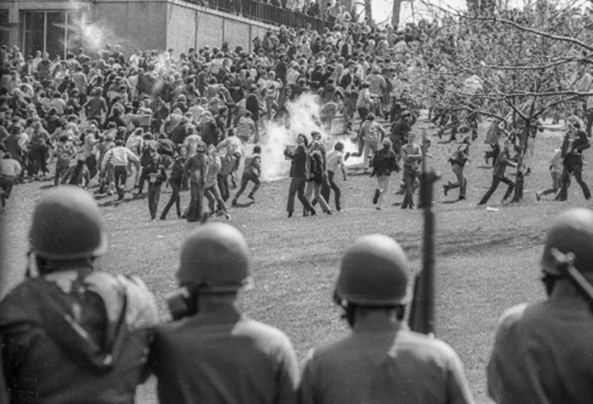
The Kent State massacre took place during a time of intense division in the United States. The Vietnam War had sparked widespread protests, especially among college students. Many Americans believed the war was unnecessary and wanted it to end. At Kent State University in Ohio, students gathered to protest President Richard Nixon’s decision to send U.S. troops into Cambodia, which expanded the war. These demonstrations were part of a national movement protected under the First Amendment, which guarantees freedom of speech and peaceful assembly.
According to the History.com article “Kent State Shooting,” tensions increased over several days, and the Ohio governor called in the National Guard. On May 4, 1970, guardsmen confronted students on campus and ordered them to disperse. Shortly afterward, they fired into the crowd. Four students were killed and nine were injured, including some who were not actively protesting. Nearly seventy shots were fired in just thirteen seconds. The event shocked the nation and became one of the most controversial uses of force against civilians in American history.
Legally, the shootings raised serious concerns about whether the National Guard’s actions were justified. The Guard is meant to maintain public safety, not to act against unarmed citizens. Many questioned whether the students posed a threat that warranted deadly force. Although investigations later criticized the Guard’s actions, criminal charges against the guardsmen did not result in convictions. For many Americans, this outcome created a sense that government officials were not held fully accountable.
Civil lawsuits followed. The families of the victims and the injured students sued the state, arguing that constitutional rights had been violated. These cases eventually led to a financial settlement and a statement expressing regret. However, no criminal punishment was imposed. This difference highlights how criminal law focuses on punishment, while civil law focuses on compensation and responsibility. Kent State is often discussed as an example of how civil settlements can acknowledge harm even when criminal charges do not lead to convictions.
Recent shootings involving ICE agents raise similar legal questions in a modern context. In these cases, federal immigration officers used deadly force during enforcement actions or protests. Officials have stated that the agents acted in self-defense, but videos and witness accounts have led some members of the public to question those explanations. As with Kent State, the central issue is whether the use of force was reasonable under the law.
Under U.S. legal standards, law enforcement officers may use deadly force only if they reasonably believe there is an immediate threat to life. This rule is intended to balance officer safety with the protection of civilians. When evidence appears to conflict with official reports, it can create doubt about whether this standard was properly applied. Just as in 1970, the public debate often centers on fairness and accountability.
Jurisdiction also plays an important role. ICE agents are federal officers, so investigations into their conduct are typically handled at the federal level. This can affect how cases are reviewed and how much information is shared with the public. At Kent State, the National Guard operated under state authority, but federal courts were involved in later legal proceedings. In both situations, questions about who has the authority to investigate and prosecute can shape the outcome.
Civil rights connect these two events as well. The students at Kent State were exercising their First Amendment rights when the shooting occurred. In the ICE-related incidents, concerns often involve due process and equal protection. When communities feel that certain groups are more likely to be harmed or targeted, it raises broader questions about whether constitutional protections are being applied equally.
Both events also had a lasting impact on public trust. After Kent State, many Americans felt that the government had placed control above citizens rights. Similarly, modern incidents involving federal agents can create distrust, especially if investigations are seen as lacking transparency. Public confidence in the legal system is essential, and when it weakens, the effectiveness of the law can suffer.
In the end, the Kent State massacre and more recent ICE shootings are not only tragic events; they are moments that test the strength of legal principles. They force the country to confront difficult questions about power, responsibility, and justice. Studying these incidents through a legal lens shows how important it is for the law to protect rights, limit authority, and ensure accountability. These conversations remain relevant today, reminding us that constitutional protections must be upheld in every generation.
Works Cited
“Kent State Shooting.” History.com, A&E Television Networks, [www.history.com/articles/kent-state-shooting](http://www.history.com/articles/kent state-shooting).
History of Violence
© 2025. All rights reserved.
Address
Skyline High School
Legal Studies Magnet Program
7777 Forney Rd
Dallas, Texas 72227
Contact
info@SkylineLaw.org
Att: Mr. H. Rodriguez, Lead Teacher