February 2025
(1) The law that damages us; (2) Religion in Schools; (3) What we need in our schools
ARTICLESFEB 2026
Genesis Fuentes, Diana Flores, and Hayley Rios
2/28/2026
By Leonardo Garcia
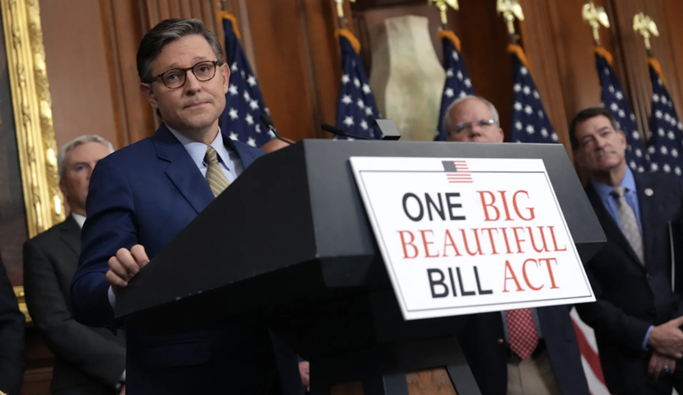
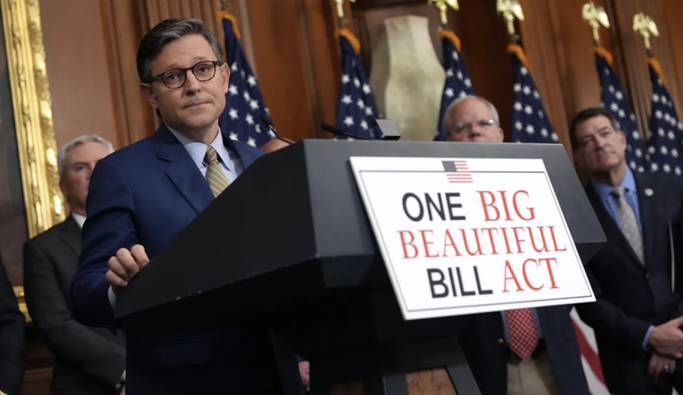
The One Big Beautiful Bill Act (“OBBBA”) represents one of the most sweeping domestic legislative efforts enacted in 2025. Signed into law by President Donald J. Trump on July 4, 2025, the Act combined tax reform, federal spending priorities, and significant policy changes affecting healthcare, social programs, infrastructure, and energy. Passed through the budget reconciliation process after a narrow, contentious legislative journey through both chambers of Congress, the Act illustrates the breadth of Congress’s Article I powers while also raising significant legal and policy questions about its long-term social consequences. See One Big Beautiful Bill Act, Pub. L. No. 119-21 (2025).
At its core, the OBBBA functioned as a comprehensive budget and tax package. The House of Representatives initially passed the bill in May 2025, after which the Senate amended key provisions before returning it to the House for final approval by a narrow margin. This procedural posture is significant because reconciliation bills are insulated from the Senate filibuster, allowing passage by a simple majority. As courts have long recognized, Congress possesses expansive authority over taxation and spending, particularly when exercising its power through duly enacted budget legislation. See U.S. Const. art. I, 8; NFIB v. Sebelius, 567 U.S. 519, 537–38 (2012).
Substantively, the OBBBA sought to extend and expand elements of the Tax Cuts and Jobs Act of 2017, while also introducing new deductions and credits aimed at middle and working-class taxpayers. Provisions increasing the child tax credit, raising the state and local tax (SALT) deduction cap, and allowing deductions for tipped and overtime income were promoted as mechanisms to stimulate economic growth and provide immediate tax relief. Legal and tax analysts noted, however, that the benefits of these provisions varied significantly depending on income level, filing status, and business structure, resulting in uneven economic outcomes among taxpayers.
Beyond tax reform, the Act made substantial changes to federal health and social programs, particularly Medicaid and Affordable Care Act (ACA) related provisions. These changes included new eligibility requirements, work verification measures, and reductions in long-term federal Medicaid spending. According to projections by the Congressional Budget Office, these provisions could result in millions of individuals losing health coverage over the coming decade. See Cong. Budget Office, Estimated Budgetary Effects of H.R. 1, the One Big Beautiful Bill Act (2025). Public health organizations warned that while the Act may reduce federal expenditures, it does so at the cost of decreased access to healthcare for vulnerable populations, raising concerns about equity and administrative burden.
The legal implications of the OBBBA have already begun to surface through litigation and judicial review. Courts evaluating challenges to specific provisions have primarily deferred to Congress’s spending authority, particularly where the statutory language clearly conditions federal funding. For example, appellate courts have rejected constitutional challenges alleging that certain Medicaid funding restrictions constitute bills of attainder or violate equal protection principles, emphasizing Congress’s discretion in allocating public funds. See Planned Parenthood Federation of America, Inc. v. Kennedy, No. 25‑1698 (1st Cir. 2025) as well as South Dakota v. Dole, 483 U.S. 203, 206–08 (1987).
The reasoning underlying these decisions reflects a long-standing judicial reluctance to second-guess congressional policy judgments embedded in budgetary legislation. As long as Congress acts within its enumerated powers and does not impose unconstitutional conditions, courts generally uphold such statutes even when their social consequences are controversial. In this sense, the OBBBA fits squarely within established constitutional doctrine, despite its far-reaching impact.
In conclusion, the One Big Beautiful Bill Act stands as a defining example of modern omnibus legislation, blending tax relief, spending reductions, and policy reform into a single statute. While the Act provides immediate economic benefits to certain taxpayers, it also introduces significant long-term trade-offs, particularly in healthcare access. As implementation continues and legal challenges progress, the OBBBA will remain central to debates over congressional power, social welfare policy, and the proper balance between fiscal restraint and public protection. Its legacy will likely be shaped not only by its economic outcomes but also by how courts and agencies interpret and apply its provisions in the years to come.
Citations
One Big Beautiful Bill Act, Pub. L. No. 119-21 (2025). U.S. Const. Art. I, 8.
Nat’l Fed’n of Indep. Bus. v. Sebelius, 567 U.S. 519 (2012).
Cong. Budget Office, Estimated Budgetary Effects of H.R. 1, the One Big Beautiful Bill Act (2025), available at https://www.cbo.gov.
South Dakota v. Dole, 483 U.S. 203 (1987).
Tax Cuts and Jobs Act of 2017, Pub. L. No. 115-97 (2017).
Planned Parenthood Federation of America, Inc. v. Kennedy, No. 25‑1698 (1st Cir. 2025)
The One Big Beautiful Bill Act: Legislative Power, Policy Trade-Offs, and Emerging Legal Implications
© 2025. All rights reserved.
Address
Skyline High School
Legal Studies Magnet Program
7777 Forney Rd
Dallas, Texas 72227
Contact
info@SkylineLaw.org
Att: Mr. H. Rodriguez, Lead Teacher