10th Grade ~ Rising Objection
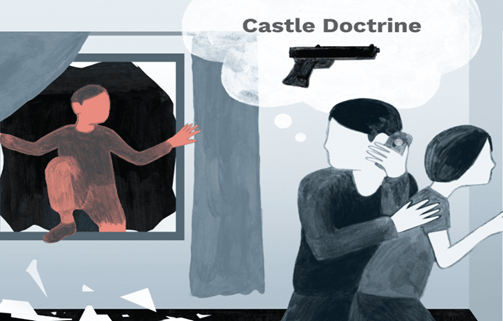
Have you ever heard of the Castle Doctrine?
This law is a form of self-defense, allowing individuals to use reasonable—even deadly—force, if necessary, to protect themselves or their families from unlawful intruders in their homes. One of the most significant aspects of this doctrine is that it removes the duty to retreat, meaning a person does not have to flee before defending themselves.
I personally appreciate this law because it provides a sense of security and confidence. It reassures me that if someone were to break into my home or even my car, I would not face legal consequences for taking action to protect myself. The Castle Doctrine recognizes that in moments of danger, individuals should have the right to defend themselves and their loved ones without hesitation. To me, it is comforting to know that my right to self-defense is not only acknowledged but also protected under the law.
CASTLE DOCTRINE: The Law that Protects You
(September 2025) by Kayla McGee
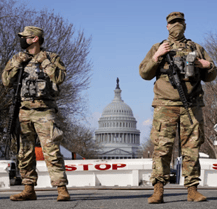
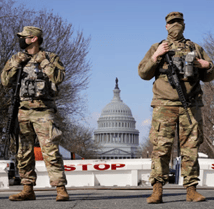
Have you recently checked the news and noticed the immense movement of armed forces?
Well, the Insurrection Act of 1807 is a U.S. federal law that gives the president the power to deploy the U.S. military or federalize the National Guard to suppress civil insurrection and rebellion.
Let's begin with the word insurrection. What does it mean? Whilst the word itself isn't defined by federal law, it is generally understood to refer to a violent uprising and organized resistance against the government and its regulations. It is stated, "Insurrection often involves acts intended to overthrow, disrupt, or challenge the authority of the United States or impede the enforcement of federal laws." (Headquarters, V. N. (2021). Eisner Gorin LLP.)
This act has often been invoked to obliterate labor strikes and to end protest movements. This act has been invoked multiple times, some of which include the following years;
1861 - President Abraham Lincoln
1957 - President Dwight D. Eisenhower
1960s - John F Kennedy
1992 - George H.W. Bush
Now you may be wondering, "How is this connected to our current government?" President Trump has recently shown a great interest in invoking this act. His escalating efforts to dispatch federalized troops to cities have come to everyone's attention.
There have been 2 previous attempts by President Trump to invoke this act. The first was during his first presidential term in 2020, when he considered invoking this act during the George Floyd protests. Secondly, in 2025, "Trump again said he was mulling the use of the Insurrection Act after a federal judge blocked him from sending National Guard troops to Portland, Oregon, which the president argues is overrun by left-wing "domestic terrorists" (Faguy, 2025).
There have been many people standing up to these attempts, one of which stated, "If there's a bad faith invocation of the Insurrection Act to send federal troops to go beat up anti-ICE protesters, there should be a general strike in the United States," - Kevin Carroll
In conclusion, President Trump is considering invoking the 19th-century law against democratic cities soon.
INSURRECTION ACT OF 1807:
The exceeding power Trump may soon hold.
(October 2025) by Allison Brizuela




I am proud to say that my experience with Youth & Government was genuinely excellent. Although I wasn’t always confident in myself during certain rounds, I was honored to be named Best Lawyer alongside Hailey, my classmate from Mock Trial, who I’m sure gave an outstanding performance. The entire event was filled with good sportsmanship, and everyone I met was kind and supportive.
In the first round, we unexpectedly served as the defense instead of the prosecution. My performance felt a little shaky, but I believe we outperformed the opposing team and secured a win. The evaluator offered constructive critiques but ultimately praised our overall effort.
By the second round, we were on defense again. I felt more adjusted and confident, yet that round proved to be our weakest. My delivery wasn’t perfect, I felt intimidated, and we ended up losing. Still, the opposing team offered me kind compliments, which meant a lot.
In the third round, we finally took on the prosecution role. The opposing team seemed less prepared, and we earned another victory. The judge complimented me on being a strong, energetic witness, which boosted my confidence.
Our final round placed us back on defense, and I believe it was our best performance yet. The case could have gone either way, but we ultimately lost. Even so, our team received encouraging feedback and recognition for our effort.
At the awards ceremony, I was thrilled to be named Best Lawyer alongside Hailey. The moment was significant—I felt my hard work had paid off, and I was deeply moved when my mom told me how proud she was. I even cried from happiness. Still, part of me wonders if I truly deserved the award.
Overall, the experience was overwhelmingly positive, and I would love to participate again next year and for many years to come.
From Doubt to Best Lawyer: My Journey Through Youth & Government Rounds
(November 2025) by Valerie Cortez
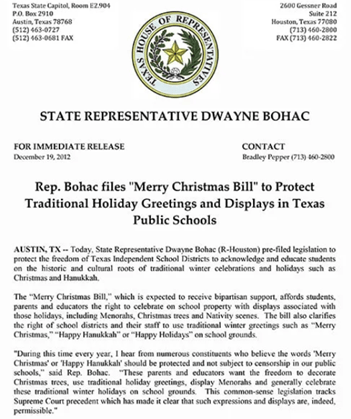
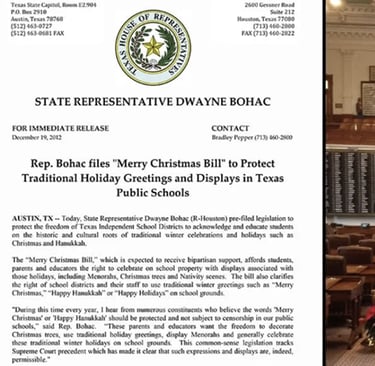
You know how schools often seem very careful about saying “Merry Christmas” or putting up holiday decorations? In 2013, the Texas Legislature passed a law known as the “Merry Christmas Bill,” or House Bill 308, to address this issue. Essentially, the state government stepped in to clarify that schools may recognize holidays. The law states that teachers and students may use traditional greetings such as “Merry Christmas,” “Happy Hanukkah,” or “Happy Holidays” without fear of punishment. It also allows public schools to display holiday decorations, including a Christmas tree or a menorah. However, if a school chooses to include a religious display, it must also include symbols from other religions or a secular, non-religious symbol, such as a snowman.
For someone trying to understand how laws affect everyday life, this bill is essential because it provides a clear example of the government regulating what can be said or displayed in a public space, specifically, a school hallway. It shows how lawmakers attempt to resolve conflicts arising from cultural and religious diversity within public institutions.
As a tenth grader considering a future career in law, I find this bill especially interesting because it demonstrates how the legal system works in practice. When studying the Constitution, students learn about the First Amendment, which addresses religion. One part, the Establishment Clause, prevents the government from establishing an official religion, while another part, the Free Exercise Clause, protects individuals' rights to practice their own faith. House Bill 308 represents the Texas Legislature’s attempt to balance these two principles. The law seeks to ensure that public schools are not promoting Christianity while also protecting the right of students and teachers to express themselves. I find it fascinating to analyze whether this law successfully protects religious freedom or instead creates new confusion, making it a strong example of how laws are written to address real-world cultural issues.
The Texas "Merry Christmas Bill"
(December 2025) by Maria Mejía
© 2025. All rights reserved.
Address
Skyline High School
Legal Studies Magnet Program
7777 Forney Rd
Dallas, Texas 72227
Contact
info@SkylineLaw.org
Att: Mr. H. Rodriguez, Lead Teacher