⚖️ December 2025: Modern Governance Under Pressure: Expression, Statutory Strategy, and Digital‑Age Constitutionalism
Jesus Hernández, Leonardo García, Daphne Salas


By Jesus Hernandez
Public schools exist at the intersection of constitutional protections and government authority. While students retain First Amendment rights within schools, those rights coexist with the state's obligation to maintain religious neutrality and ideological restraint. The Supreme Court has long recognized that students do not "shed their constitutional rights to freedom of speech or expression at the schoolhouse gate." At the same time, the Court has been unequivocal that public schools, as state actors, may not endorse or impose religious belief.
Recent actions by Texas political leaders, including efforts to mandate religious content in public schools and to allow partisan organizations such as Turning Point USA access, raise significant constitutional concerns. These initiatives blur the critical distinction between protected private student expression and government-sponsored speech, which the Establishment Clause and the prohibition against viewpoint discrimination are intended to limit.
This essay argues that the imposition of religious messaging in public schools, combined with preferential access for ideologically aligned political organizations, violates the First Amendment by (1) constituting impermissible government endorsement of religion and (2) undermining the requirement of viewpoint neutrality in student speech forums.
The foundational case governing student speech is Tinker v. Des Moines Independent Community School District, where the Court held that student expression is protected unless it causes a material and substantial disruption to school operations. Tinker emphasized that student expression is private speech, entitled to constitutional protection even within the structured environment of public education.
Later cases clarified the limits of this protection. In Bethel School District No. 403 v. Fraser, the Court upheld restrictions on lewd or vulgar student speech. In Hazelwood School District v. Kuhlmeier, the Court allowed schools to regulate school-sponsored speech that could reasonably be perceived as bearing the imprimatur of the institution.
Hazelwood establishes that when speech appears to be endorsed by the school, it is considered government speech rather than private speech. This distinction is decisive in cases involving religious or ideological messaging mandated or promoted by the state.
The Supreme Court has consistently treated public schools as a uniquely coercive environment for Establishment Clause purposes. In Engel v. Vitale, the Court invalidated a state-sponsored prayer, even though participation was voluntary. Similarly, in Abington School District v. Schempp, the Court struck down Bible readings in public schools, holding that the state may not promote religious doctrine through its educational system.
These cases reflect a broader constitutional principle: the government may not support religion, especially in settings where students are required to attend and are subject to institutional authority. This concern remains relevant despite recent changes in Establishment Clause jurisprudence.
In Kennedy v. Bremerton School District, the Court protected a public employee's private religious expression, emphasizing that the prayer at issue was personal and not coercive. However, Kennedy does not authorize the state to mandate or institutionalize religious expression. The Court explicitly distinguished between private religious exercise and government endorsement of religion.
When a governor or legislature mandates religious displays, curricula, or messaging in public schools, the speech is clearly governmental. These mandates cross the constitutional line established in Engel and Schempp by turning schools into vehicles for religious promotion.
Facilitating access for partisan political organizations also raises significant First Amendment concerns. When the government creates a limited public forum, it must remain viewpoint-neutral.
In Board of Education v. Mergens, the Court held that a school that permits noncurricular clubs may not exclude religious student groups, emphasizing neutrality rather than endorsement. Likewise, in Rosenberger v. Rector & Visitors of the University of Virginia, the Court ruled that denying funding to a student organization based on its religious viewpoint constituted unconstitutional viewpoint discrimination.
Neutrality requires equal treatment of all viewpoints. If state officials facilitate access for ideologically aligned organizations such as Turning Point USA while discouraging or excluding opposing perspectives, the state abandons neutrality. It endorses a particular ideology that directly conflicts with First Amendment principles.
This concern reflects the Court's warning in West Virginia State Board of Education v. Barnette, which held that no government official may prescribe what is orthodox in matters of opinion. Public schools cannot serve as instruments for ideological conformity without violating constitutional norms. Those who oppose religious content in schools often argue that such measures reflect historical tradition or moral education rather than religious endorsement. They may cite the Court's increasing emphasis on history and tradition in Establishment Clause cases.
This argument fails because the Supreme Court has consistently rejected using public schools to advance religious doctrine, regardless of historical framing. In Schempp, the Court acknowledged the Bible's historical significance but still prohibited its devotional use in schools. The issue is not the historical value of religion, but whether the state is promoting religious belief. Mandated religious content in classrooms goes beyond historical instruction and constitutes endorsement. It asserts that allowing organizations like Turning Point USA to operate in schools promotes free speech and civic engagement, consistent with First Amendment values.
While student-initiated political speech is protected, state-facilitated access for a specific partisan organization raises concerns about viewpoint discrimination. Under Rosenberger, the government may not favor one viewpoint over another within a forum it controls. If access is granted selectively or with administrative encouragement, the speech becomes associated with government endorsement, violating the neutrality required by the First Amendment.
Some argue that Kennedy signals a shift away from the strict separation of church and state, legitimizing religious initiatives in schools. This interpretation misreads Kennedy. The Court protected private religious expression but reaffirmed that coercive or state-sponsored religious activity remains unconstitutional. Mandated religious messaging in public schools is fundamentally different from private prayer and remains prohibited under long-standing precedent.
The First Amendment demands vigilance in protecting both student expression and religious neutrality in public schools. While students may engage in religious and political speech, the state may not impose or favor such speech through its educational institutions. Mandating religious content or granting preferential access to partisan organizations violates the Establishment Clause and the prohibition against viewpoint discrimination. Repeatedly emphasized, public schools must not be used to prescribe orthodoxy in matters of belief or ideology. When the state crosses that line, it undermines the constitutional freedoms the First Amendment was designed to secure.
Case Citations
Tinker v. Des Moines Indep. Cmty. Sch. Dist., 393 U.S. 503, 506 (1969).
Engel v. Vitale, 370 U.S. 421 (1962).
Tinker, 393 U.S. at 509.
Bethel Sch. Dist. No. 403 v. Fraser, 478 U.S. 675 (1986).
Hazelwood Sch. Dist. v. Kuhlmeier, 484 U.S. 260 (1988).
Engel, 370 U.S. at 430.
Abington Sch. Dist. v. Schempp, 374 U.S. 203 (1963).
Kennedy v. Bremerton Sch. Dist., 597 U.S., 142 S. Ct. 2407 (2022).
Good News Club v. Milford Cent. Sch., 533 U.S. 98 (2001).
Bd. of Educ. v. Mergens, 496 U.S. 226 (1990).
Rosenberger v. Rector & Visitors of Univ. of Va., 515 U.S. 819 (1995).
W. Va. State Bd. of Educ. v. Barnette, 319 U.S. 624, 642 (1943).
Schempp, 374 U.S. at 225.
Rosenberger, 515 U.S. at 828–29
Kennedy, 142 S. Ct. at 2426.
State-Sponsored Religion, Student Speech, and Viewpoint Discrimination in Public Schools
By Leonardo Garcia
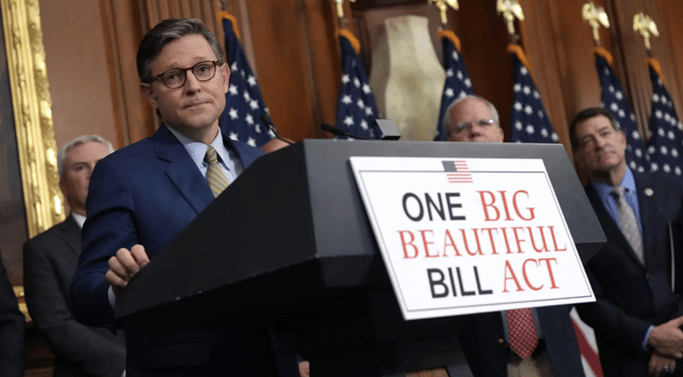
The One Big Beautiful Bill Act (“OBBBA”) represents one of the most sweeping domestic legislative efforts enacted in 2025. Signed into law by President Donald J. Trump on July 4, 2025, the Act combined tax reform, federal spending priorities, and significant policy changes affecting healthcare, social programs, infrastructure, and energy. Passed through the budget reconciliation process after a narrow, contentious legislative journey through both chambers of Congress, the Act illustrates the breadth of Congress’s Article I powers while also raising significant legal and policy questions about its long-term social consequences. See One Big Beautiful Bill Act, Pub. L. No. 119-21 (2025).
At its core, the OBBBA functioned as a comprehensive budget and tax package. The House of Representatives initially passed the bill in May 2025, after which the Senate amended key provisions before returning it to the House for final approval by a narrow margin. This procedural posture is significant because reconciliation bills are insulated from the Senate filibuster, allowing passage by a simple majority. As courts have long recognized, Congress possesses expansive authority over taxation and spending, particularly when exercising its power through duly enacted budget legislation. See U.S. Const. art. I, 8; NFIB v. Sebelius, 567 U.S. 519, 537–38 (2012).
Substantively, the OBBBA sought to extend and expand elements of the Tax Cuts and Jobs Act of 2017, while also introducing new deductions and credits aimed at middle and working-class taxpayers. Provisions increasing the child tax credit, raising the state and local tax (SALT) deduction cap, and allowing deductions for tipped and overtime income were promoted as mechanisms to stimulate economic growth and provide immediate tax relief. Legal and tax analysts noted, however, that the benefits of these provisions varied significantly depending on income level, filing status, and business structure, resulting in uneven economic outcomes among taxpayers.
Beyond tax reform, the Act made substantial changes to federal health and social programs, particularly Medicaid and Affordable Care Act (ACA) related provisions. These changes included new eligibility requirements, work verification measures, and reductions in long-term federal Medicaid spending. According to projections by the Congressional Budget Office, these provisions could result in millions of individuals losing health coverage over the coming decade. See Cong. Budget Office, Estimated Budgetary Effects of H.R. 1, the One Big Beautiful Bill Act (2025). Public health organizations warned that while the Act may reduce federal expenditures, it does so at the cost of decreased access to healthcare for vulnerable populations, raising concerns about equity and administrative burden.
The legal implications of the OBBBA have already begun to surface through litigation and judicial review. Courts evaluating challenges to specific provisions have primarily deferred to Congress’s spending authority, particularly where the statutory language clearly conditions federal funding. For example, appellate courts have rejected constitutional challenges alleging that certain Medicaid funding restrictions constitute bills of attainder or violate equal protection principles, emphasizing Congress’s discretion in allocating public funds. See Planned Parenthood Federation of America, Inc. v. Kennedy, No. 25‑1698 (1st Cir. 2025) as well as South Dakota v. Dole, 483 U.S. 203, 206–08 (1987).
The reasoning underlying these decisions reflects a long-standing judicial reluctance to second-guess congressional policy judgments embedded in budgetary legislation. As long as Congress acts within its enumerated powers and does not impose unconstitutional conditions, courts generally uphold such statutes even when their social consequences are controversial. In this sense, the OBBBA fits squarely within established constitutional doctrine, despite its far-reaching impact.
In conclusion, the One Big Beautiful Bill Act stands as a defining example of modern omnibus legislation, blending tax relief, spending reductions, and policy reform into a single statute. While the Act provides immediate economic benefits to certain taxpayers, it also introduces significant long-term trade-offs, particularly in healthcare access. As implementation continues and legal challenges progress, the OBBBA will remain central to debates over congressional power, social welfare policy, and the proper balance between fiscal restraint and public protection. Its legacy will likely be shaped not only by its economic outcomes but also by how courts and agencies interpret and apply its provisions in the years to come.
Citations
One Big Beautiful Bill Act, Pub. L. No. 119-21 (2025). U.S. Const. Art. I, 8.
Nat’l Fed’n of Indep. Bus. v. Sebelius, 567 U.S. 519 (2012).
Cong. Budget Office, Estimated Budgetary Effects of H.R. 1, the One Big Beautiful Bill Act (2025), available at https://www.cbo.gov.
South Dakota v. Dole, 483 U.S. 203 (1987).
Tax Cuts and Jobs Act of 2017, Pub. L. No. 115-97 (2017).
Planned Parenthood Federation of America, Inc. v. Kennedy, No. 25‑1698 (1st Cir. 2025)
The One Big Beautiful Bill Act: Legislative Power, Policy Trade-Offs, and Emerging Legal Implications
By Daphne Salas
Recent developments in constitutional and regulatory law reveal a judiciary increasingly willing to recalibrate long-standing legal doctrines in response to technological change, national security concerns, and shifting political priorities. Between 2024 and 2025, courts at both the federal and state levels confronted issues that test the outer boundaries of the First Amendment, antitrust enforcement, and criminal procedure. These cases illustrate not merely isolated doctrinal adjustments, but a broader trend toward granting the government expanded regulatory authority, often at the expense of traditional civil liberties. This essay examines three areas where that shift is most visible: digital speech regulation, antitrust enforcement against technology monopolies, and the scope of state power in criminal justice and surveillance.
In TikTok, Inc. v. Garland, the Supreme Court upheld federal legislation requiring the divestiture or ban of TikTok due to national security concerns related to foreign ownership. The Court rejected the argument that the statute constituted an impermissible restriction on speech, emphasizing Congress’s authority to act in the interest of national security. While framed as a regulation of corporate ownership rather than expression, the law's practical effect is to remove a central platform used by millions of Americans for speech and political engagement.
The decision signals a meaningful shift in First Amendment analysis. Historically, courts have treated laws that burden speech, especially when they do so at such a sweeping scale, with deep skepticism. By deferring to legislative judgments grounded in national security, the Court appears to lower the constitutional barrier for future regulations targeting speech intermediaries. Critics warn that this approach risks allowing the government to suppress speech indirectly by targeting the platforms that host it. This concern resonates strongly in an era where digital spaces function as modern public forums.
The Court’s willingness to relax First Amendment scrutiny is also evident in Free Speech Coalition v. Paxton, which upheld a Texas law requiring age verification for access to certain online content. Rather than applying strict scrutiny, the Court used intermediate scrutiny, emphasizing the state’s interest in protecting minors. This analytical move departs from prior precedent that treated adult access to lawful speech as deserving of the highest constitutional protection.
Together, these cases suggest that the Court is increasingly receptive to content-based digital regulations when justified by child protection or national security. While these interests are undeniably significant, the resulting doctrinal shift raises serious questions about whether traditional First Amendment safeguards remain robust in the digital age.
Antitrust law has also undergone a notable transformation, particularly in cases involving dominant technology firms. In United States v. Google LLC, a federal district court held that Google unlawfully monopolized key segments of the digital advertising market in violation of the Sherman Act. The ruling emphasized exclusionary conduct and the reinforcement of market power through vertical integration, concepts rooted in traditional antitrust theory but applied to modern, multi-sided digital markets.
This case reflects a broader revival of structural antitrust enforcement after decades of judicial restraint driven by consumer welfare analysis. Courts now appear more willing to recognize that control over digital infrastructure can distort competition even in the absence of immediate price effects. The Google litigation thus marks a turning point in how courts conceptualize monopoly power in the digital economy.
At the same time, courts have limited administrative agencies' authority to regulate technology markets. In Ohio Telecom Association v. FCC, the Sixth Circuit concluded that the Federal Communications Commission lacked statutory authority to impose common-carrier obligations on broadband providers. The decision significantly undermined efforts to reinstate net neutrality rules and reinforced a broader judicial skepticism toward expansive agency power.
The tension between aggressive antitrust enforcement and constrained regulatory authority reflects an unsettled legal framework. While courts recognize the dangers of concentrated tech power, they remain divided over which institutions are best equipped to address it.
In criminal law, courts have likewise demonstrated increased tolerance for expanded state authority. The Florida Supreme Court’s decision to uphold non-unanimous jury recommendations in death penalty cases represents a stark departure from the historical emphasis on unanimity as a safeguard against wrongful execution. By allowing an 8–4 jury vote to support a death sentence, the court prioritized legislative judgment over evolving standards of decency and procedural reliability.
Concerns about state power extend beyond the courtroom. Expanded federal surveillance initiatives aimed at domestic political movements have sparked renewed debate over the First Amendment’s protection of association and dissent. While the government frames these efforts as necessary for public safety, civil liberties advocates argue that such programs risk chilling lawful political activity, echoing the abuses of prior eras.
Finally, courts have begun confronting the implications of artificial intelligence in legal practice. Recent sanctions imposed on attorneys for submitting AI-generated filings containing fabricated citations underscore the judiciary’s insistence that technological convenience cannot replace professional responsibility. These cases serve as an early warning that while AI may transform legal practice, it does not diminish the ethical duties owed to courts and clients.
The legal developments of 2024 and 2025 reveal a judiciary navigating unprecedented challenges posed by technology, security concerns, and institutional authority. Across constitutional law, antitrust enforcement, and criminal procedure, courts have shown a growing willingness to accommodate expanded government power, often by reinterpreting or narrowing long-standing doctrinal protections. Whether this trend represents a necessary adaptation or an erosion of fundamental liberties remains an open and pressing question. As digital platforms continue to shape public discourse and economic life, the balance struck by courts today will define the contours of American law for decades to come.
Citations
TikTok, Inc. v. Garland, 602 U.S. (2025).
Free Speech Coal. v. Paxton, 602 U.S. (2024).
United States v. Google LLC, 2024 WL (D.D.C. 2024).
Ohio Telecom Ass’n v. FCC, 95 F.4th (6th Cir. 2025).
Apprendi v. New Jersey, 530 U.S. 466 (2000).
Ramos v. Louisiana, 590 U.S. 83 (2020).
Model Rules of Pro. Conduct r. 1.1 (Am. Bar Ass’n 2023).
The Evolving Landscape of Constitutional and Regulatory Law in the Digital Age
© 2025. All rights reserved.
Address
Skyline High School
Legal Studies Magnet Program
7777 Forney Rd
Dallas, Texas 72227
Contact
info@SkylineLaw.org
Att: Mr. H. Rodriguez, Lead Teacher